star*(life)
October 23, 2026
Politecnico di Torino, Italy
October 23, 2026
Politecnico di Torino, Italy
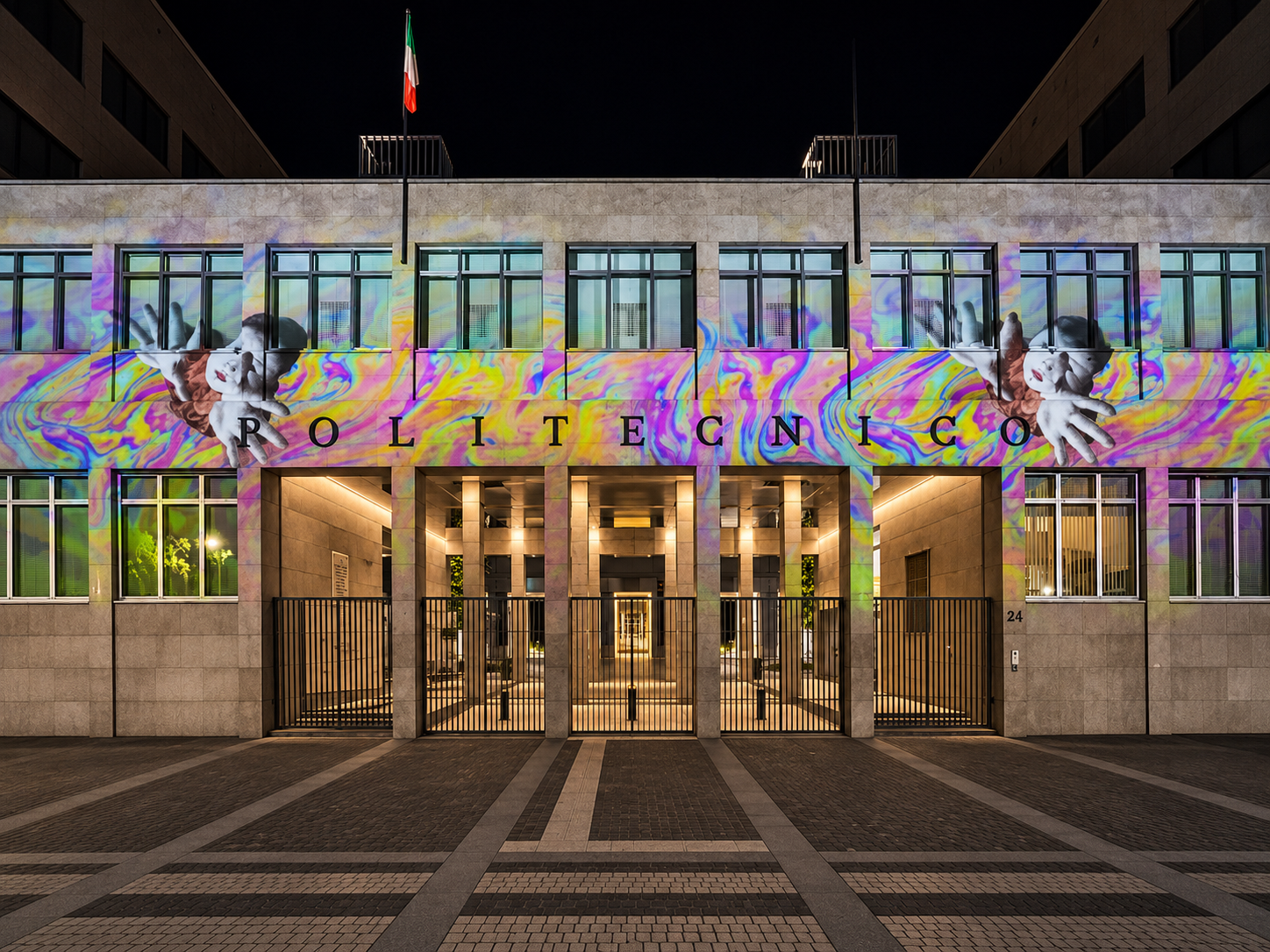
I remember listening to the radio when the first footsteps imprinted the dusty surface of the Moon in 1969. It was seen as the single greatest achievement of creative collaboration up to that moment in human history. It was achieved on a foundation of science and improvisation by a team with diverse backgrounds and a common goal. Within that moment, there was a mix of poetry and engineering: a collective act of imagination had become a physical reality, and humanity had entered a new paradigm.
Just as the Sun illuminates its barren surface, people have projected their notions of cultural identity onto the Moon. Imagine a superimposition of these characters and stories. Asians see rabbits, while Europeans see a smiling face; Native Americans see a grandmother; Africans, a hard-working frog; Scandinavians, a boy and a girl carrying a bucket of water. The Moon becomes a shared screen onto which different cultures project their own histories, symbols, and ways of seeing.
In 1835, one of the first great fake-news stories was published in the New York Sun, and it involved the fictional discovery of a civilization of wild, utopian, hair-covered creatures seen through a newly polished telescope focused at the distant Moon.
A few years ago, I met a young woman who was convinced that we had never walked on the Moon and that the Moon landing was a hoax perpetrated by the U.S. government. She claimed that a famous movie director had been hired to film the entire thing in advance in a concrete bunker north of Los Angeles. It has been said that the only thing harder to do than travel to the Moon would be to fake traveling to the Moon.
In the post-truth era, news, science, morality tales and conspiracy theories are unidentified objects with different outcomes. Each is a sign to be interpreted, a force to be reckoned with, yet under the influence of conspiratorial thought, we are always the victim frozen, disenfranchised. The stories we create about the unknown therefore shape not only what we believe, but also how we understand our place within a collective.
The heavens have always generated narratives, gods, and predictions by which we trace our fears, aspirations, and desires. Wandering asteroids from other galaxies arrive to reveal within its hardened core, peptides, precursors to DNA and water trapped within. Seeds of life are everywhere. The universe offers material evidence, but imagination gives that evidence meaning.
As we look upward to navigate our mundane lives, it turns out that the ground we stand upon is made of stars—indeed, the same material scattered across the universe. This recognition collapses the distance between the cosmic and the personal. We are not merely observers of the universe; we are made from it.
Our expansion, physically and optically, into space has opened new territory through image technologies. The unknown unfolds farther and farther away as our vision and understanding of human nature become clearer here on Earth.
The Moon landing has been described as a Cold War race, but the estimated 400,000 contributors to the project were a mosaic of backgrounds. Many workers were immigrants or the children or grandchildren of immigrants—German, Italian, Irish, Polish, British, Scandinavian, and Jewish-European—as well as African American and Native American workers. Their composite cosmologies, creativity, and skills moved us forward together; identities converging around a common goal.
As we search for information and new life forms, we must also chart a course here on Earth through the mirage of social manipulation and mysterious government releases of UFO reports.
Someday, in the not-too-distant future, we may be identified as aliens from another perspective.