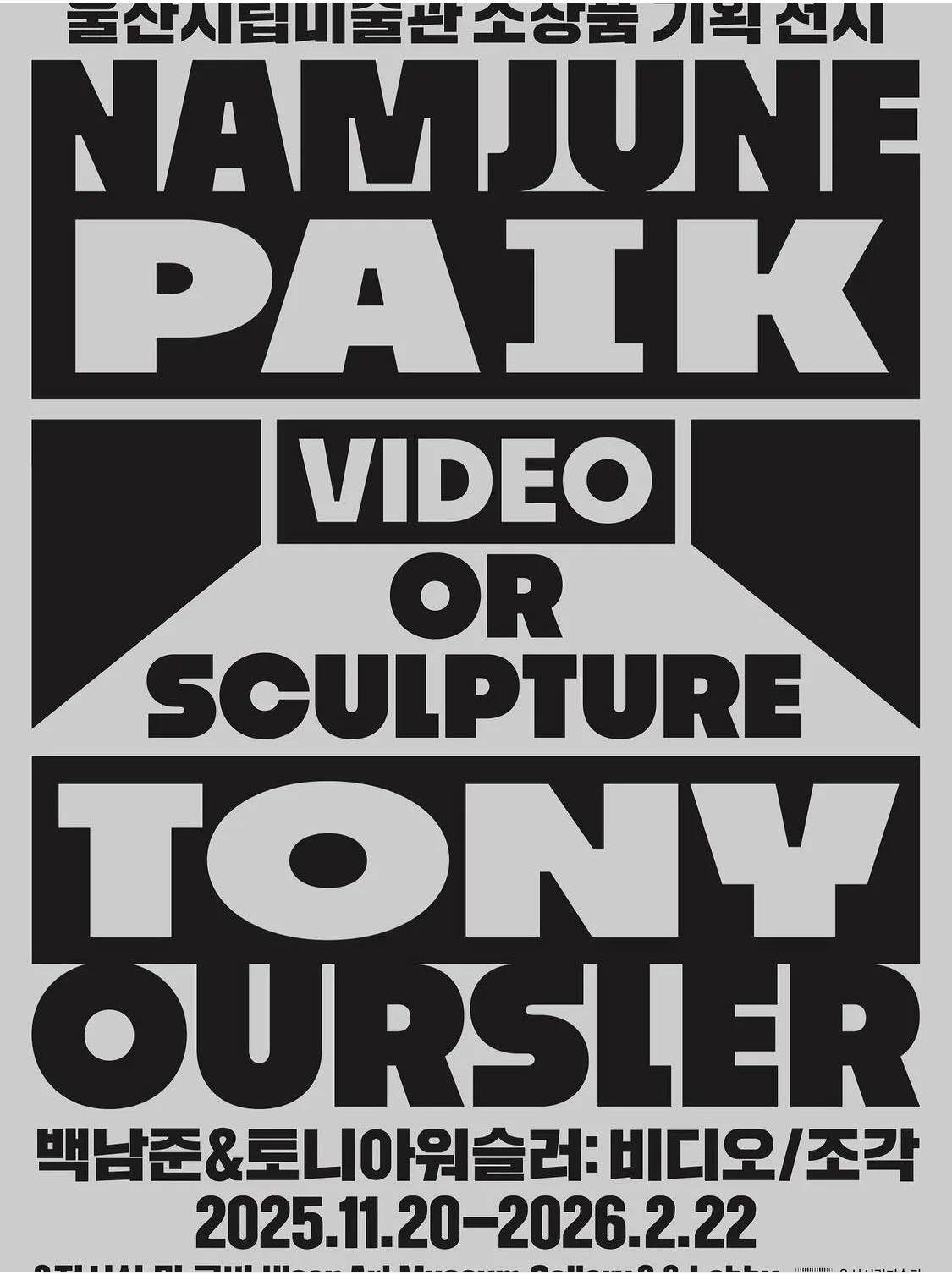
Nam June Paik & Tony Oursler: Video or Sculpture
November 20th - February 2nd, 2026
Ulsan Museum, Korea
Tony Oursler reveals the inspiration behind his large-scale installation work, LOCK 2, 4, 6.
Don’t miss your chance to experience this work, which is on view in ‘Nam June Paik & Tony Oursler: Video or Sculpture,’ at the @UlsanArtMuseum in South Korea through Sunday, February 22.
The exhibition title is derived from the work of psychologist Peter Wason, whose studies on hypothesis testing revealed the mechanisms of confirmation bias. In one well-known experiment, Wason asked participants to determine the rule governing the number sequence 2, 4, 6. While most subjects proposed increasingly complex theories, few identified the simple underlying rule—ascending numbers. The study demonstrated how individuals tend to interpret evidence in ways that reinforce existing assumptions rather than challenge them.
The installation adopts this insight as an epistemological thought experiment, questioning our capacity for self-knowledge and opening a discourse on volition and fate. Oursler approaches the mind–body problem intuitively, structuring the work around three interrelated systems personified by three principal characters, broadly aligned with mind, body, and the unknown. These systems are distributed spatially across three floors: one governed by consciousness and remote control, another dominated by physical and haptic agency, and a third shaped by compulsive risk-taking, chance, and stochastic loss of control. A tension between intention and inevitability unfolds across these zones, implicating the viewer in the struggle.
The installation functions as a feedback loop—epistemological, social, anatomical, and linguistic—linking these systems through video projections, soliloquies, and ritualized performances displayed across a network of theatrical screens. The result is a labyrinth of uncanny processes that seek, and repeatedly fail, to achieve equilibrium among competing drives, compulsions, and substances.
Viewers become active participants by moving between elements and floors, tracing chains of cause and effect. On the upper level, a chorus of virtual, human-scale women poses questions and poetic declarations, humorously reflecting historical and contemporary attempts to categorize consciousness—from Sigmund Freud to functional MRI imaging. In collaboration with philosopher Dan Lloyd of Trinity College, Oursler translated fMRI data from psychological test subjects into musical compositions, creating a real-time audiovisual unfolding of neural activity.
Across the remaining floors, order gives way to obsession, chance, and collapse: choruses heckle the viewer, systems leak and repeat, structures are built and destroyed, and entropy reigns. The work stages consciousness itself as an unstable, recursive process—forever attempting, and failing, to resolve itself into coherence.